Seif al-Islam could be tried in Libya if conditions right, says ICC

Fadi El-Abdallah, ICC spokesman, at American University of Beirut in April 2010. Screenshot: American University of Beirut
A spokesman for the International Criminal Court told RFI on Monday that it is discussing the transfer of Moamer Kadhafi’s son Seif al-Islam with the Libyan rebel National Transitional Council (NTC). The court recognises that he could be tried in Libya if the authorities are “serious” and “capable” of carrying out a “genuine” prosecution.
Interview: Fadi El-Abdallah, ICC spokesman, The Hague, 22nd August 2011
Air France refuses to carry deported gay Cameroon man from UK

An Air France plane at Heathrow airport. Photo: Mathieu Marquer
A gay Cameroonian man who faces expulsion from the UK will be allowed out on bail from a detention centre after Air France refused to transport him. A statement from the UK Border Agency seen by RFI on Monday says asylum seeker Joseph Kaute was “disruptive” during attempts to deport him. He will receive a temporary reprieve from being returned to Cameroon.
Egypt’s new trade minister tells RFI he will not take office
Egypt’s new Minister of Trade and Industry Ahmed Fekri Abdel Wahab told RFI on Tuesday that he would not be taking office after all. The announcement of his appointment had been met with some criticism over a possible conflict of interest between his private businesses and serving the needs of the Egyptian people.
Interview: Ahmed Fekri Abdel Wahab
Cabinet reshuffle will convince some in Tahrir, says new finance minister
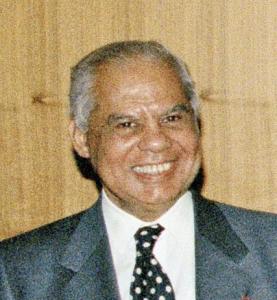
Hazem el-Beblawi, 1996. Photo: UN Photo/Milton Grant
Egypt’s new finance minister Hazem el-Beblawi told RFI on Sunday that protesters in Tahrir Square would be “at least partially satisfied” with the government’s cabinet reshuffle. Egypt’s Prime Minister Essam Sharaf has handed a list of proposed ministers to the ruling Supreme Council of the Armed Forces for approval. The new cabinet is expected to be unveiled on Monday.
“The new cabinet reflects more the feeling on the street than the previous one, where some names, rightly or wrongly, were associated with the past regime,” says Beblawi.
Beblawi replaces Samir Radwan who was appointed shortly before toppled president Hosni Mubarak left.
AU 2011 summit in Malabo, Equatorial Guinea

African Union summit
Interview: Henry Bellingham, UK Minister for Africa
Interview: Mohamed Omaar, Somalia Deputy Prime Minister
Interview: Deng Alor, Minister for Regional Cooperation, South Sudan
Interview: Mohamed al-Orabi, Foreign Minister, Egypt
Press Conference Questions: Jacob Zuma, President, South Africa
Report: Summit curtain raiser
Report: The beginning of talks
Report: Opening ceremony
Report: Framework agreement on Libya
Interview: Henry Bellingham, UK Minister for Africa, 29th June 2011
Mediation efforts in Libya and Sudan were high on the agenda at the AU summit in Malabo. While observer missions at the summit tried to influence African delegations during closed-door meetings on issues such as the crisis in Libya.
Interview: Mohamed Omaar, Somalia’s Deputy PM, 30th June 2011
Somalia’s Shebab rebels are “a spent force”, Deputy Prime Minister Mohammed Omaar told RFI in an interview at the AU summit in Malabo. Omaar promises a new president will be elected next year and insists that government forces will win territorial control.
Radio France Internationale – Al-Shebab a spent force, says Somalia’s Deputy PM

Delegates at the African Union summit 2011
Interview: Deng Alor, Minister for Regional Cooperation, South Sudan, 29th June 2011
The Sudanese government and the Sudan People’s Liberation Movement signed a deal that aims to bring an end to fighting in the border state of South Kordofan. There has been heavy fighting in South Kordofan since 5 June between government forces and militia aligned to the SPLA, the ex-rebel army. The agreement follows mediation efforts by AU mediator and former South African President Thabo Mbeki. The conflict has displaced more than 70,000 people, according to the United Nations.
Interview: Mohamed al-Orabi, Foreign Minister, Egypt, 1st July 2011
The theme of this year’s AU summit in Malabo is youth empowerment. The empowerment of youth has not been felt more strongly in recent times than in Tunisia or Egypt. In Egypt violent protests once again hit Tahrir Square on Wednesday having a knock-on effect on the country’s currency, which hit a six year low.
Press Conference Questions: Jacob Zuma, President, South Africa, 2nd July 2011
The 17th African Union rounded up in Malabo on Friday. Following a number of meetings the AU tabled a proposal for a framework agreement on a political situation to the crisis in Libya. This agreement complements the work of the AU’s high-level mediation group and calls for continuing dialogue. But with the acceptance of Libyan leader Moamer Kadhafi that he will not be part of the negotiation process. After the summit’s closing ceremony South African President Jacob Zuma gave a press conference.

Outside the Sipopo conference centre, Malabo, Equatorial Guinea
Report: Summit curtain raiser, 29th June 2011
“Here at the purpose-built Sipopo conference centre things are starting to hot up – and the word on everyone’s lips is Libya. AU Commission Chairman Jean Ping told RFI yesterday that they won’t change tact on Nato’s military intervention. They’re calling for a political solution, with some kind of transition including Libyan leader Moamer Kadhafi. We’ve also learnt that members of rebel National Transitional Council will be coming to Malabo, granted visas by the authorities, but with no access to the conference venue. Possibly a lobbying opportunity for them – whilst giving the AU a failsafe position, making sure they don’t shun them completely. Libya’s foreign minister Abdul Ati Al-Obeidi also was present at last night’s meetings. But the only sign you’ll get of Kadhafi in Malabo at this conference is his face adorning the flags of African leaders on the road from the airport to the flashy venue. RFI’s Daniel Finnan, reporting from Malabo.”Report: The beginning of talks, 30th June 2011
“Discussions have already begun – and as well as a high level meeting of Nepad, the New Partnership for Africa’s Development, yesterday, there’s also been a number of closed door bilateral and multilateral talks. The AU mediation group on Libya met again last night, with presidents from South Africa, Mauritiana, Uganda, Mali and Congo Brazzaville. On the table over the next few days will be the continuing issue of Libya – how many African leaders will openly support the departure of Kadhafi, or what form could a transition take? With Sudan – what comes next in the on-going border disputes over Abyei and South Kordofan. Plus Somalia – will the AU be satisfied with the confirmation of a new Prime Minister by the Somali parliament – while will Uganda and Burundi want to contribute more troops to the AU peacekeeping force in the country. Reporting for RFI, this is Daniel Finnan in Malabo.”Report: Opening ceremony, 1st July 2011
“The day started off with the grand opening ceremony and discussions on the summit’s theme – youth empowerment. Before leaders eventually sat down and talked about the burning issue of the day – Libya. ‘Somalisation’ – that’s the phrase increasingly used by the AU Commission Chairman Jean Ping, when he talks about the dangers of the ongoing conflict. Earlier in the morning RFI learnt that the rebel National Transitional Council had arrived at the summit, and met with the foreign ministers from Chad, Niger, Mali, Mauritiana and Cote d’Ivoire. One of the Benghazi envoys Mansour Saif al-Nasr said countries are ok with the departure of Libyan leader Moamer Kadhafi, but only some say it publicly. Meanwhile, the Libyan government delegation continues its lobbying in Malabo, at some times just metres away from the rebels. At the end of the day, the evening meeting yielded no public announcement – but maybe we’ll see some kind of development on the AU’s roadmap plan, later today. Daniel Finnan, RFI, Malabo.”Report: Framework agreement on Libya, 2nd July 2011
“After two days of discussions the African Union has tabled a new framework agreement on Libya. It calls for Kadhafi to accept that he cannot be part of any negotiation process on finding a political solution to the crisis. The framework doesn’t explicitly say that Kadhafi shouldn’t be part of any transition, if a settlement were to be reached. That was clear during comments made during the press conference. South African President Jacob Zuma said the framework answered all the questions. Although he wouldn’t be drawn on the question of a transition. Meanwhile, the AU also took a decision on the arrest warrant for Kadhafi, issued by the ICC, saying member states should not cooperate. And ask that the UN Security Council cancel the ICC process on Libya in the interests of justice and peace in the country. In passionate comments during the press conference, AU Commission Chairman Jean Ping made comparisons with American compliance and quoted a head of state, saying the court’s prosecutor is a joke. RFI’s Daniel Finnan reporting from Malabo.”Paris protesters call for Syria’s al-Assad to go

Demonstrators at the Place du Trocadero call for regime change in Syria, 11 June 2011. Photo: LA Bagnetto
Syrian demonstrators took to the streets of cities across the world on Saturday in protest against the Syrian regime. In downtown Montreal about 300 people gathered, chanting, “the people want an end to the regime”. While in Paris near the Eiffel tower activists were demanding for an end to corruption and tyranny.
Radio Report: Anti-Assad protests in Paris
Tunisian blogger Slim Amamou calls for post-revolutionary new world order

Amamou at L’engagement 2.0, Le Grand Salon de la Sorbonne, Paris
Tunisian blogger Slim Amamou was in Paris on Tuesday to debate the use of social networks during the Tunisian revolt, and the future of politics shaped by online activism. Amamou, the former Tunisian Secretary of State for Youth and Sport, joined four other bloggers who played a key role in the Tunisian revolution for a conference focused on the role technology played in the country’s uprising. The event, hosted by Jeannette Bougrab, the French Secretary of State for Youth and Community, comes as political parties in Tunisia and the country’s electoral commission debate over the timetable for elections. On Monday the Progressist Democratic Party and the Islamist Ennahda movement conceded a possible delay for the vote. Organisers of the ballot would like to see it moved to October.
Interview: Slim Amamou, Tunisian blogger
S.Africa sets out its stall ahead of Durban climate change conference

Construction of the Medupi power plant in Lephalale, South Africa, April 2009. Photo: Eskom
Delegations from South Africa, India, China and Brazil rounded up a meeting in Durban on Sunday focused on climate change. It was the second such meeting this year and comes ahead of November’s UN climate change talks. The four nations were expected to adopt a common strategy and decide how they will negotiate their position with world’s richest economies.
Interview: Edna Molewa, South Africa’s Minister for Water and Environmental Affairs
Congo has to take the lead in November elections, says Crisis Group’s Délétroz
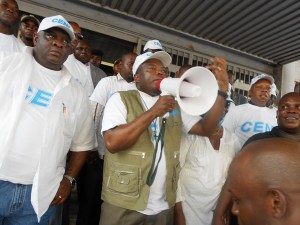
Representatives of the DRC’s electoral commission in Kinshasa, 7 May. Photo: CENI
Anger and consternation dominated the feelings amongst Congolese pro-democracy activists at a meeting with representatives from the French foreign ministry in Paris on Monday. During discussions about the Democratic Republic of Congo’s 28th November polls, three themed round tables focused on the electoral process, security, justice and impunity. There are worries that the government is not ready to improve on 2006’s dismal voting conditions, and many Congolese are unhappy with French support for elections that they already see as flawed.
Interview: Alain Délétroz, Vice President, International Crisis Group
EU to give five million euros for Guinea election

EU Commissioner Piebalgs on the Forécariah bridge, 100 kilometres east of Conakry, 7 May 2011
The European Union is to provide five million euros to help Guinea run a delayed general election. Wrapping up his two-day visit to Guinea on Saturday the European Commissioner for Development Andris Piebalgs told RFI that support for the country’s parliamentary elections is “crucial” to avoid future ethnic violence.
“Elections are crucial because countries in Africa have a lot of tribal history and it is very difficult to find any other method to avoid violence and poor representation of each and every ethnic group,” Piebalgs says.
Guinea has not had a legislature since 2008 when it was dissolved by former military junta leader Moussa Dadis Camara. A 155-member National Transition Council has been acting in place of parliament since February 2010. Read the rest of this entry »


 custom-made radio